Reel Iron · TV Car History
Ferrari Sued the Most Famous Car on Television — Then Sent Two of Their Own.
In 1984, Miami Vice put a Ferrari Daytona Spyder on screen and made it one of the most recognized cars in America. The problem: it wasn't a Ferrari. It was a Corvette in a fiberglass costume — and the lawsuit that followed accidentally created the most successful product placement in Ferrari's history.
$49K
Per Replica Purchased
2
Testarossas Donated
1989
Federal Court Ruling
$1.75M
Surviving Car Today
Most viewers never knew. The Ferrari Don Johnson drove through the neon-lit streets of Miami in the first two seasons of Miami Vice was not a Ferrari. It had never been built by Ferrari. It had never been touched by anyone in Maranello. It was a 1972 Chevrolet Corvette with custom-fabricated fiberglass panels glued to it, finished to look — at a distance, in motion, under TV lighting — like a 1972 Ferrari 365 GTS/4 Daytona Spyder.
The deception lasted just long enough to make the imposter famous. And that fame is what brought the lawyers.
Ferrari Said No. Twice.
When Miami Vice went into pre-production in 1984, the producers approached Ferrari North America directly. The pitch made sense — a cocaine-era Miami vice cop driving a confiscated drug runner's exotic was exactly the kind of premise Ferrari should have wanted associated with its brand.
Ferrari said no. Flatly. This wasn't unusual — Ferrari had already refused the same request from Magnum P.I., forcing that production to purchase its 308 GTS at retail. Ferrari did not loan cars to television. Period.
So the Miami Vice production turned to a gray-market exotic-car importer named Al Mardekian, who connected them to a company called McBurnie Coachcraft in San Diego. McBurnie specialized in one product: convincing-looking Daytona Spyder replicas built on Chevrolet Corvette C3 chassis. The production purchased two Daytona replicas from Mardekian for $49,000 each — about $150,000 in 2026 money.
The replicas had problems even before the lawyers arrived. The primary car had been built on a wrecked Corvette that was two inches shorter on one side than the other — a manufacturing defect McBurnie had baked into his templates. The fiberglass panels weren't symmetrical. Most viewers never noticed, because the camera angles never let them see both sides of the car in the same shot.
None of that mattered for two full seasons. The black Daytona became one of the most recognized cars on American television. T-shirts. Lunch boxes. Magazine covers. The Daytona was, by 1985, a Ferrari icon — except it wasn't a Ferrari.
Watch · Chapter at 4:45
How Enzo Ferrari Found Out — And What He Did Next.
The federal lawsuit that ended the Daytona wasn't filed by a marketing department. It came from the top of the company. The Reel Iron documentary walks through how Ferrari built its trademark case, who filed it in the Southern District of California, and why the 1989 ruling reshaped American IP law for vehicle design.
Watch the Lawsuit Chapter →The Settlement: Two Testarossas for One Execution.
Here's what the production agreed to. The McBurnie Daytonas would be removed from the show. In exchange, Ferrari would donate two factory-fresh 1986 Testarossas — Monospecchio single-mirror cars, retail-equivalent value at the time of roughly $135,000 each — for use as Crockett's new car.
The condition was specific and non-negotiable: the Daytona replicas had to be visibly destroyed on screen. Ferrari wanted the imposter killed in public, in front of the audience that had spent two seasons believing it was real.
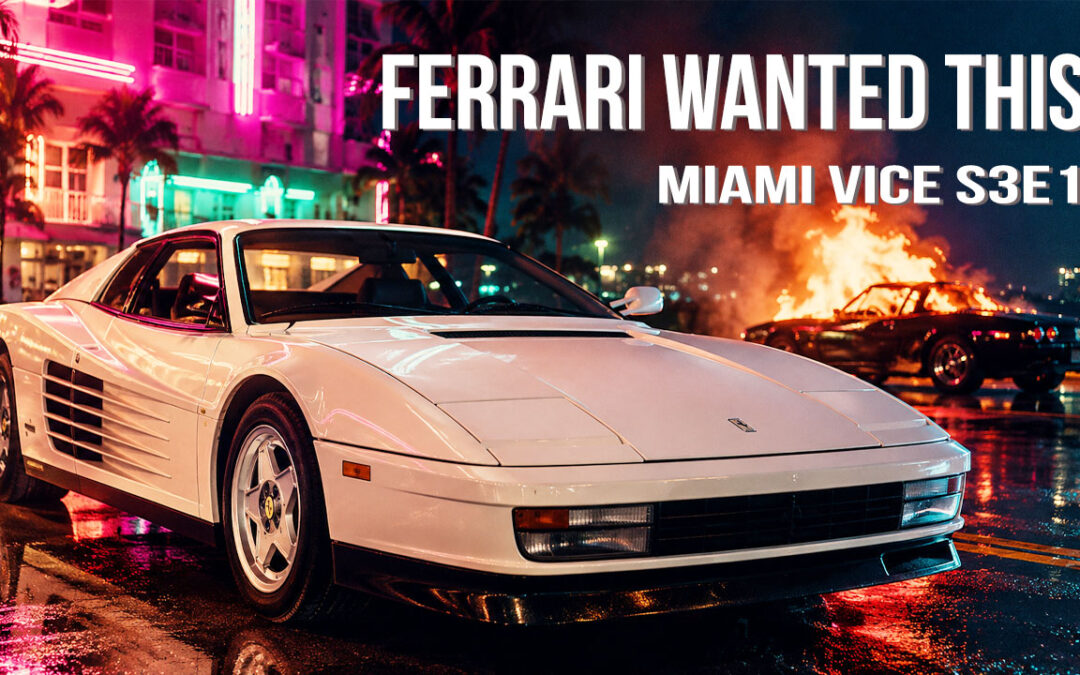
The producers added one final twist. They asked Ferrari to let them keep the Daytonas long enough to film a proper on-screen death. Ferrari agreed. And in the season three premiere — an episode titled When Irish Eyes Are Crying — Sonny Crockett's Daytona is destroyed in a staged ambush. A rocket-propelled grenade strikes the car during an illegal arms deal. The Daytona is engulfed in flame. The replica era ends in a single shot.
Except — and this is the detail almost no one catches — the production cheated even at the funeral. The car blown up on screen wasn't one of the original two Daytonas. It was an empty body shell. The actual replicas were preserved, and one of the originals is reportedly still in private collector hands today.
How White Paint Made the Icon.
The Testarossas arrived from Italy painted black with beige leather interiors. Producer Michael Mann took one look and ordered them repainted white.
Mann's reasoning was specific to the show's production style. Miami Vice shot heavily at night, against dark Florida skylines, under neon lighting. A black Ferrari disappeared into those backgrounds. A white Ferrari glowed against them.
Two donated Ferraris, one Michael Mann paint decision, and the most recognizable car of 1980s television was born.
What happened next is the part Ferrari did not anticipate. The white Testarossa didn't just replace the Daytona. It eclipsed it. By the end of Miami Vice's third season, the white Testarossa was driving Ferrari's brand recognition in the United States to levels the company had never seen. Sales of road-going Testarossas climbed sharply. The Monospecchio variant became a collector's grail.
Ferrari spent the 1980s fighting to keep its brand off a television show. And in winning that fight, Ferrari created the most successful product placement in the company's history.
The lawsuit, meanwhile, kept rolling. Ferrari's victory against McBurnie set a precedent the company used for decades to suppress other replica manufacturers. Daytona replicas became scarce. The few that survived the 1989 ruling now trade at premium prices specifically because the lawsuit made them impossible to produce — a McBurnie Daytona, paradoxically, is more valuable today than it was when Miami Vice was buying them new.
And the stunt-car problem on the show? The production solved it quietly. For the Testarossa's high-speed and crash sequences, the crew built a fiberglass replica based on a 1972 De Tomaso Pantera — chosen specifically because its wheelbase was nearly identical to a real Testarossa's. Ferrari knew. Ferrari did not sue this time. The white Testarossa was making the brand too much money for anyone to care.
Watch · Chapter at 8:00
The Paint Decision That Built the Icon.
Michael Mann's white-paint order is one of the most consequential single decisions in 1980s television. The Reel Iron documentary breaks down exactly why the original black Testarossas were unusable on screen, the production-style logic behind the repaint, and how the lawsuit-driven car became more famous than any deliberate marketing campaign Ferrari had ever run.
Watch the Paint Decision Chapter →The Survivors.
The two original Testarossas were used through the end of the series in January 1990. After the show ended, both were sold off into private collections, certified by Ferrari North America and Ferrari Classiche as authentic Miami Vice production vehicles. One of those original two cars — chassis-documented, paint-history verified, with roughly 16,000 miles on the clock — was listed for sale in subsequent years at $1.75 million.
The Daytona replicas — the ones the show didn't actually destroy — are harder to trace. At least one survived the production and entered the collector market quietly, where Daytona replicas, now permanently scarce after the 1989 court ruling, became their own niche category.
The arithmetic of the whole episode is worth sitting with. Ferrari refused to lend a car to a TV show. The show used a fake one. Ferrari sued. The fake got destroyed. Ferrari donated two real cars to replace it. The real cars made Ferrari more famous than any deliberate marketing campaign could have. And forty years later, the car the company sent as a legal settlement is worth nearly two million dollars at auction.
Full Documentary Timeline
The most successful product placement Ferrari never wanted.
The Reel Iron documentary tells the full story — the McBurnie lawsuit, the rocket-launcher execution, Michael Mann's white-paint order, the Pantera-based stunt cars Ferrari quietly tolerated, and the $1.75 million survivor still on the collector market today. The corporate paradox. The legal mechanics. The icon that exists because Ferrari sued to make it exist.
Watch the Reel Iron Documentary →