Reel Iron Documentary
Christopher Nolan Had Four Custom Batmobiles Destroyed on Camera. He Did It on Purpose.
In 2007, every Tumbler stunt in The Dark Knight was performed with a real, hand-built, one-of-a-kind vehicle. No CGI. No shortcuts. Four of them didn't make it out of production — and the ones that did are now worth millions.
Most filmmakers making a $185 million superhero movie would have looked at their Batmobile stunt sequence — a full-speed pursuit through downtown Chicago, involving jumps, crashes, and a deliberately staged rollover — and made a sensible decision. They would have used CGI for the dangerous parts. They would have protected the props. They would have built a hero car for close-ups and rendered the rest in post.
Christopher Nolan made a different decision. Every Tumbler that appears in The Dark Knight is a real, drivable, purpose-built vehicle. Every stunt was performed by a human being — specifically by stunt driver George Cottle — in an actual car on an actual street. And when those cars were destroyed in the course of making the film, they stayed destroyed. There was no digital resurrection, no backup render, no composited replacement waiting in a hard drive somewhere.
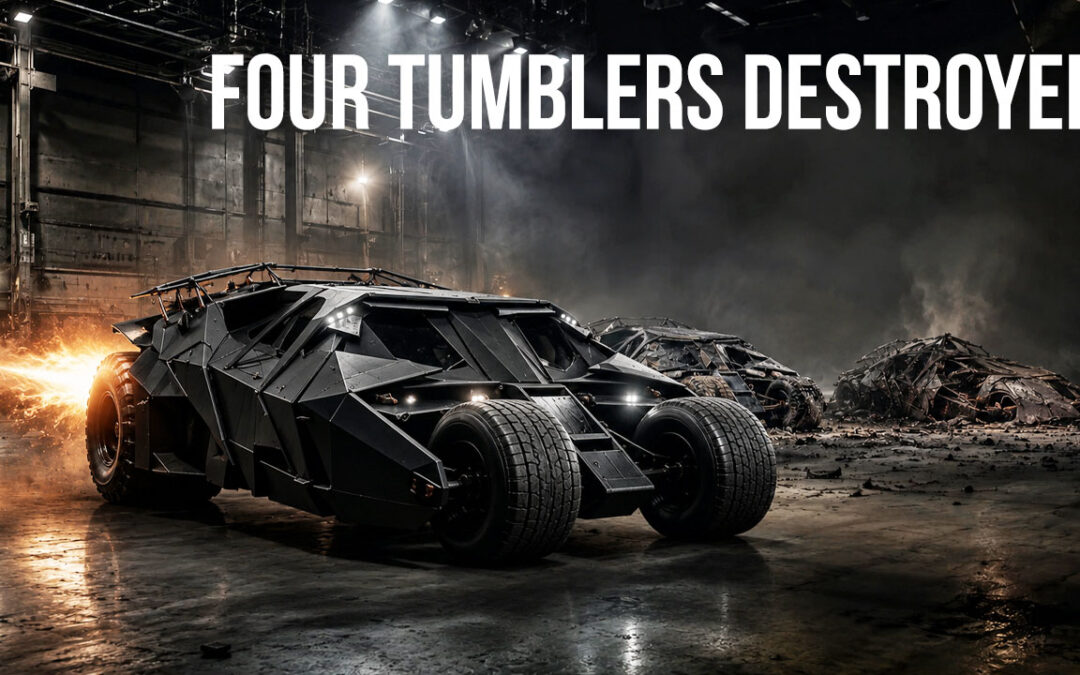
Four hand-built Tumblers were lost in production. Each one had been fabricated largely from scratch, with no donor vehicle underneath it, at a cost that made each loss genuinely painful from a budget standpoint. The total fleet investment ran north of a million dollars. Nolan spent it anyway — because he believed, with the conviction of someone who had staked his entire directorial reputation on practical filmmaking, that audiences could feel the difference between a real crash and a simulated one even when they couldn't explain why.
He was right. And the proof is in what happened next: The Dark Knight became the first superhero film to gross over a billion dollars at the global box office. Whether that validates the destruction of four irreplaceable custom vehicles is a question worth examining carefully — because the answer is more complicated than it first appears.
The garage where the Tumbler was born
Before there was a fleet of Tumblers, before there was a stunt coordinator or a fabrication budget, there was a garage and a pile of plastic model kits. Nolan and production designer Nathan Crowley developed the Tumbler's initial form by cutting up scale models — the kind you'd find in a hobby shop — and assembling hybrid shapes until something clicked. It's a design process so lo-fi it borders on absurd when you set it against the finished vehicle, but it produced one of the most immediately recognizable cars in cinema history.
The concept that emerged from those model kit sessions was unlike any previous Batmobile interpretation. Where Tim Burton's 1989 version was a long, finned, gothic sculpture built on Lincoln Futura DNA, the Tumbler was something categorically different: a military bridging vehicle, essentially, with a jet engine intake sitting where the hood ornament would be on a normal car. Nolan and Crowley weren't designing a car — they were designing a weapon that happened to have a cockpit.
That distinction mattered enormously for what came next. A weapon doesn't need to look elegant. It needs to look functional, inevitable, and slightly threatening even at rest. The Tumbler achieved all three — and it did it through a design process that began with a pair of scissors and a hobby knife rather than a CAD terminal.
Building a car that did not exist
The fabrication challenge the Tumbler presented was unlike anything the production vehicle industry had encountered in the modern era. There was no donor car. There was no existing platform to modify, no chassis to borrow, no suspension geometry to adapt from a production vehicle. Every Tumbler had to be engineered from first principles — frame, suspension, drivetrain, body — as a completely original machine.
This is not how film vehicles are typically built. The economics of prop fabrication strongly favor starting with something that already exists and reshaping it. You take a Corvette platform, or a motorcycle frame, or a go-kart chassis, and you build the fantasy on top of an engineering reality that someone else already solved. The Tumbler couldn't do that. Its proportions, its wheelbase, its ground clearance, its cockpit placement — none of it mapped onto anything in production.
The consequence was a vehicle that required its own engineering solutions for problems that had never been solved before. Steering geometry. Weight distribution. The placement of the engine relative to the chassis. All of it had to be worked out from scratch, multiplied across multiple units, with the clock running and a production schedule that didn't have patience for extended R&D cycles. The team pulled it off. But understanding what that actually required reframes what you're looking at every time a Tumbler appears on screen.
In the documentary
The Reel Iron breakdown of why building the Tumbler from scratch — no donor car, no existing platform — was a genuinely unprecedented fabrication challenge starts at 3:15 and covers the engineering decisions that most production retrospectives never get specific enough to address.
Watch on YouTube →Chicago traffic jams and a civilian crash
When production moved to Chicago for the Tumbler chase sequences, the city became a live set in ways that created consequences nobody fully anticipated. The sequences involved real streets, real intersections, and a vehicle that — while entirely functional — was also an object so visually extraordinary that it stopped people in their tracks the moment it appeared.
Traffic jams developed. Civilians pulled over. And in at least one documented incident, a driver was involved in a crash that investigators attributed to distraction — specifically to the distraction of watching a Tumbler move through downtown Chicago traffic at speed. The production had brought Batman's car into the real world, and the real world responded the way you'd expect it to: with the complete suspension of normal attentiveness.
This is what practical filmmaking at that scale actually looks like. It isn't just a creative choice — it's a logistical commitment that ripples outward into the city hosting the production, into the lives of people who weren't on the call sheet, into insurance conversations and permit negotiations and damage assessments. CGI doesn't cause traffic jams. A real Tumbler, driven by George Cottle through the Loop at speed, absolutely does.
The Chicago chapter
The documentary gets into the full scope of what the Chicago shoot actually disrupted — including the civilian incident that never made the press kit — at the 6:30 mark. It's the sequence that makes Nolan's practical filmmaking commitment feel most consequential, and most genuinely costly, in human rather than financial terms.
Watch on YouTube →Why the destruction was worth a billion dollars
The argument for spending a million dollars to build vehicles you intend to destroy is, on its face, a hard one to make. CGI in 2007 was sophisticated enough to render a convincing Tumbler crash. The production had the budget. The technology existed. And preserving those vehicles would have meant preserving objects that are, by any reasonable measure, extraordinary artifacts of film history.
Nolan's counterargument — implicit in every practical stunt sequence he has ever committed to — is that there is something audiences register in real physical destruction that they don't register in simulated destruction, even when they can't identify the source of that feeling. The weight of a real object hitting real asphalt produces a visual and auditory signature that no render farm has yet fully replicated. The tension in a stunt performed by a human being in actual danger produces an on-screen quality that motion capture and CGI approximation still fall short of.
Whether that argument fully holds in the age of photoreal visual effects is genuinely debatable. But in 2008, when The Dark Knight crossed a billion dollars and became the cultural event of the year, it felt like a closed case. The destruction had purpose. The investment had returned. Four Tumblers were gone, and the film that consumed them had become one of the highest-grossing and most critically acclaimed superhero movies ever made.
Where the survivors are now — and what the wrecks became
Of the Tumblers that survived production, several have been accounted for through a combination of auction records, museum acquisitions, and private collection documentation. The market for verified production vehicles from the Nolan Batman trilogy has proven, perhaps predictably, to be extraordinary.
What's stranger — and more interesting from a collector standpoint — is what happened to the destroyed units. A Tumbler that was deliberately wrecked on camera during production, with documented provenance and verifiable damage consistent with its on-screen appearance, sold for $2.99 million. Not a pristine hero car. A destroyed one. The wreckage itself became a collectible at a price that would have covered the entire original fleet fabrication budget with money left over.
There's a logic to that valuation, even if it feels counterintuitive. The destroyed Tumbler isn't valuable despite its damage — it's valuable because of it. The damage is proof of presence. It's physical evidence that this specific object was on that street in Chicago, driven by George Cottle, during the making of one of the defining films of the 2000s. The wreck is the documentation. And documentation, in the collector market for significant screen-used vehicles, is worth more than cosmetic condition.
What's in the documentary — chapter by chapter
Four Built. Four Destroyed. One Billion Dollar Argument.
The Reel Iron documentary on the Tumbler Batmobile covers the full story — the model kit garage sessions, the from-scratch engineering, the Chicago chaos, the stunt driver who walked away from four wrecks, and the destroyed prop that sold for $2.99 million. The complete production history of the most consequential film vehicle of the 2000s, with no filler and no shortcuts.
Watch the Reel Iron Documentary →