
Reel Iron Documentary
In 1968, CBS Was About to Cancel Mannix. One Phone Call — and One Car — Changed Everything.
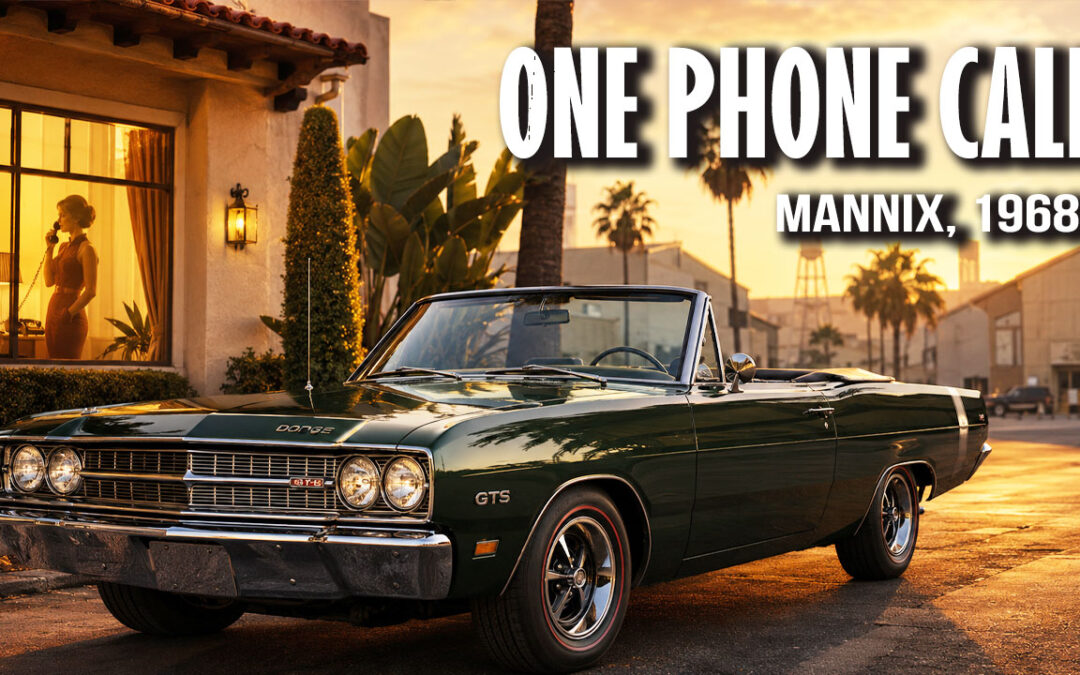
The Dodge Dart GTS wasn't just a prop. It was a lifeline for a show on the wrong side of a corporate war, custom-built by George Barris to save something nobody in Hollywood believed in anymore.
Television history is full of shows that got saved at the last minute — by a ratings surge, a passionate network executive, a fan campaign that arrived just in time. What it isn't full of is shows saved by a car. But that's the story of Mannix, and it's stranger and more specific than the legend suggests.
By 1968, the show was drowning. The premise was alienating audiences. The studio behind it — Desilu Productions, Lucille Ball's company — was being swallowed in a corporate acquisition that would eventually fold it into Paramount. CBS was circling the cancellation decision. And the man at the center of it all, a detective named Joe Mannix, was driving the wrong car for the wrong show with the wrong concept wrapped around him.
What came next involved a phone call from one of the most powerful women in Hollywood, a custom build order placed with George Barris, and a dark green Dodge Dart GTS convertible that would anchor 194 episodes across eight seasons. The car didn't just change the show's look. It changed its identity — and in doing so, helped rescue the final chapter of Lucille Ball's production legacy before the corporate tide came in for good.
A detective show with the wrong nervous system
The first season of Mannix had a concept that made total sense on paper and almost no sense on screen. Joe Mannix worked for Intertect — a massive, computer-driven private investigation firm that processed cases through mainframes and bureaucratic logic. It was modern. It was forward-thinking. It reflected exactly where corporate America thought the future was headed in 1967.
Audiences hated it. Not because they were unsophisticated, but because the whole apparatus worked against the thing they actually wanted: a tough, instinctive detective who solved problems with his fists and his gut. The computer angle didn't create tension — it diluted it. Every time Intertect's systems processed a lead, the show lost the primal forward momentum that made detective fiction compelling in the first place.
The ratings told the story clearly. CBS looked at the numbers and started making cancellation calculations. What nobody outside the inner circle knew was that the show's survival wasn't just a creative question — it was a financial one, tangled up in one of the messiest corporate transitions in Hollywood history.
Why computers killed Mannix — and what had to change
The irony of the Intertect concept is that it was precisely wrong for 1967 network television. Computers were abstract. They were institutional. They belonged to corporations and governments, not to the streets where crime actually happened in the viewer's imagination. Putting Joe Mannix inside that machine didn't make him more interesting — it made him a middle manager with a punch.
The fix, when it came, was radical in its simplicity: cut Mannix loose. Fire him from Intertect. Put him on his own, working cases independently, operating on instinct and toughness rather than algorithmic procedure. It was, in structural terms, a complete rebuild of the show's premise. And a rebuild that ambitious needed a new visual grammar — a new sense of what the show looked and felt like from the outside.
That's where the car comes in. Not as decoration, but as argument. The right car, placed correctly in the frame, tells the audience everything about a character before a word of dialogue is spoken. It says: this man makes his own rules. He moves fast. He has taste. He is not sitting behind a desk waiting for a mainframe to give him a lead.
In the documentary
The Reel Iron breakdown of why the Intertect concept was structurally broken — and the precise moment the show's producers realized a car could do what a script rewrite alone couldn't — starts at the 1:45 mark. It reframes the whole Mannix story as a lesson in visual storytelling that still applies today.
Watch on YouTube →The phone call from Lucille Ball
Here is where the story gets genuinely unusual. The decision to rebuild Mannix didn't come purely from CBS or from the show's producers. It came, at least partly, from Lucille Ball — who at that moment was operating Desilu Productions under extraordinary pressure. The studio was mid-acquisition, being absorbed into what would become Paramount Television, and Mannix was one of its last significant productions. A cancellation wasn't just a ratings failure. It was a financial wound at the worst possible time.
Ball made the call. The specifics of what was said, what was decided, and what leverage was applied belong to the documentary — but the consequence was a green light for the most significant creative overhaul in the show's history. Season 2 would have a new Mannix: independent, street-level, and driving something that looked like it belonged to a man who'd walked away from a corporation and never looked back.
It was also, as it turned out, one of the last meaningful acts of Desilu as an independent entity. The company that Lucille Ball had built — that had produced I Love Lucy, Star Trek, and Mission: Impossible — was weeks away from ceasing to exist as a standalone studio. Mannix Season 2 would be Desilu's final swing. The Dart GTS was, in a very specific sense, the car that carried the last thing Lucille Ball's company ever launched.
George Barris and the art of restraint
The build order went to George Barris — which, in the context of 1968 Hollywood custom car work, meant the job was going to the undisputed top of the field. Barris had built the Batmobile. He'd built the Munster Koach, the DRAG-U-LA, the Beverly Hillbillies truck. His shop was the address where television came when it needed a vehicle that communicated character at first glance.
What makes the Mannix Dart GTS remarkable in Barris's catalog isn't what he added — it's what he didn't. This wasn't a flamboyant custom. There were no wild fins, no theatrical paint schemes, no cartoon excess. The car is dark green, convertible, purposeful. It looks expensive without looking showy. It looks fast without looking reckless. It looks exactly like what a tough, intelligent private detective would drive if he had taste and didn't need to prove anything to anyone.
That kind of restraint is, paradoxically, harder to execute than spectacle. Barris was famous for his maximalist builds, but the Mannix commission required him to work in a completely different register — and the result is one of the most effective character vehicles in television history precisely because it knows when to stop.
The Barris angle
The documentary digs into what made the Mannix build unusual within Barris's body of work — and why a man known for wild customs produced something this restrained. The 6:30 mark is where that conversation gets specific, and it's one of the sharper observations in the whole film.
Watch on YouTube →The corporate takeover nobody mentions
The Mannix survival story is usually told as a creative turnaround — bad concept replaced by good concept, show finds its audience, runs for eight seasons. What gets left out of most retellings is the corporate context that made the stakes genuinely existential.
Gulf+Western's acquisition of Paramount, and Paramount's absorption of Desilu, was one of the defining consolidations of late-1960s Hollywood. It was the moment when the old studio model — built by founders, run by personalities, shaped by individual vision — began giving way to conglomerate logic. Desilu, specifically, represented something important: a studio built and owned by a performer, on terms she controlled. When it folded into Paramount, that era ended.
Mannix Season 2 launched inside that transition. The show's survival wasn't just good news for a TV detective — it was the last proof of concept for a studio that was already gone in everything but name. The Dart GTS became iconic because the show became iconic. But the show became iconic because enough people, at a hinge moment in Hollywood history, decided to fight for it when it would have been easier to let it go.
Two Darts, one scene, no explanation
Here's a detail that gets almost no attention in standard Mannix retrospectives: production used two Dart GTS convertibles, and there are on-screen moments where the continuity between them breaks in ways that are quietly visible if you know what to look for. Minor differences — trim details, the way light catches certain panels — that reveal the substitution without the show ever acknowledging it.
This is standard practice for hero car productions. You build or acquire multiples, you use them differently — one for close beauty shots, one for action sequences that carry real risk — and you trust that the audience won't notice the seams. Usually they don't. But the forensic details are there for anyone looking, and they tell a secondary story about how the production actually worked day to day, under real budget pressure, on a show that had only recently been pulled back from the edge.
The surviving original — and what it means
Of the two Dart GTS convertibles used in production, one is known to survive. Its existence follows the pattern of most surviving hero cars: authenticated through documentation, preserved through a combination of luck and deliberate stewardship, valued now at a level that would have been unimaginable when the show was in production.
The survival of a single car from a production that ran eight seasons and 194 episodes is, in automotive terms, actually a reasonable outcome. These were working vehicles, not museum pieces. They were driven hard, sometimes damaged, sometimes cannibalized for parts to keep the other unit running. The fact that one intact example exists is as much a function of someone caring enough to preserve it as it is of the car's original quality.
What the survivor represents, beyond its physical reality, is a specific moment in television and automotive history compressed into a single object. The Barris build. The Desilu last stand. The Lucille Ball phone call. The George Barris restraint. The corporate takeover backdrop. All of it lives in that car, if you know what you're looking at.
What's in the documentary — chapter by chapter
One car. One call. Eight seasons.
The Reel Iron documentary on the Mannix Dart GTS traces the full arc — from a failing show inside a collapsing studio to one of television's longest-running detective series — through the lens of the one car that made the difference. The Barris build details, the Lucille Ball backstory, the two-car production secret, and the surviving original are all in there. No filler. No padding. Just the real story.
Watch the Reel Iron Documentary →